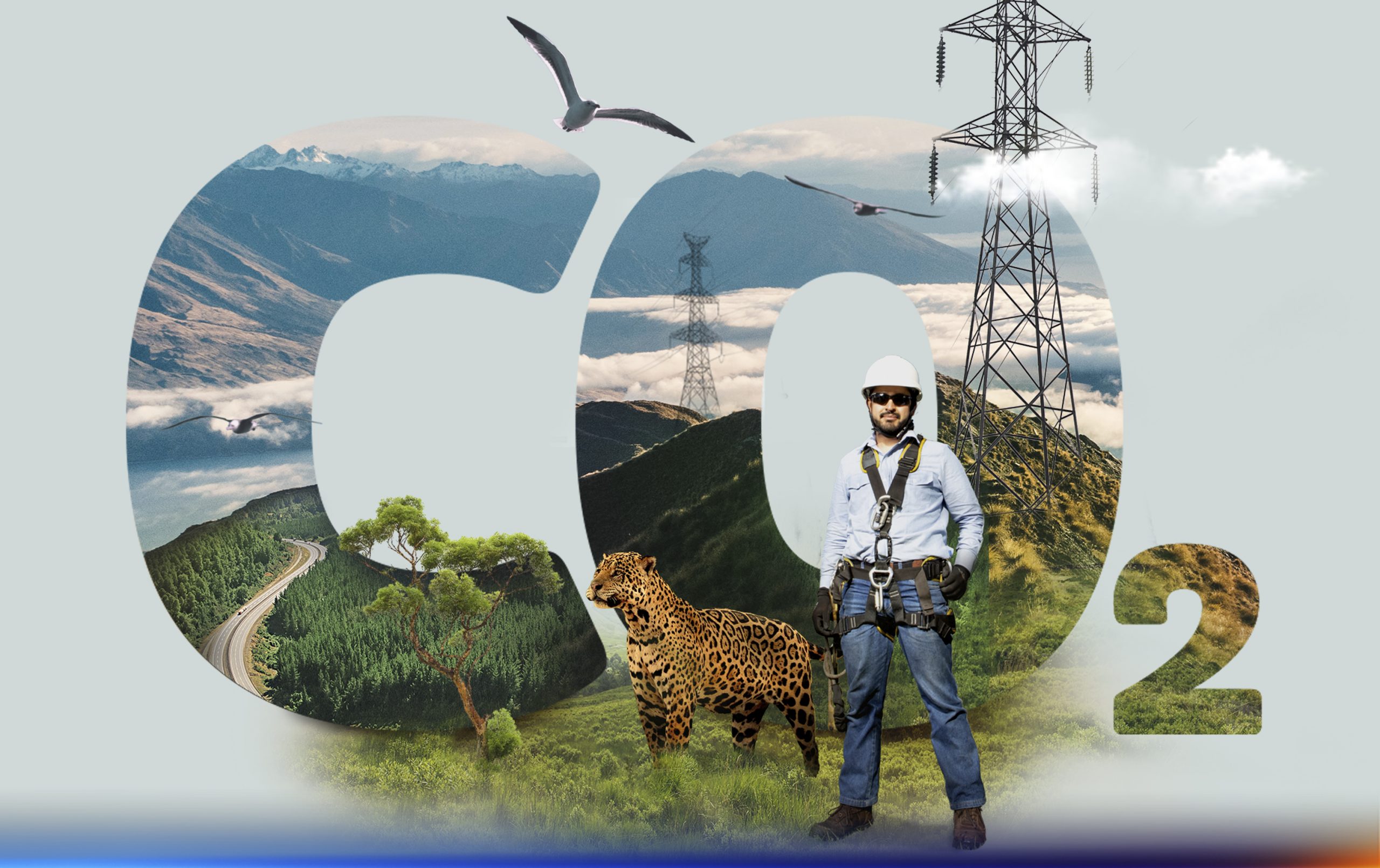
- With this milestone it becomes the transmission company certified by ICONTEC with the largest geographic coverage. Eleven companies from the three business units it operates (energy, road concessions and telecommunications) obtained the recognition.
- The certification responds to the ISA2030 Strategy, which aims to contribute, with concrete actions, to mitigating the effects of climate change and accelerating the energy transition.
- More than 48.000 km of circuits, 7.000 km of fiber optics and 714 km of roads in Latin America were reviewed and certified for the implementation of actions to reduce and offset greenhouse gas emissions.
ISA obtained from ICONTEC the carbon neutrality certification in scopes I and II[1] (operation and maintenance of assets) for 11 of its companies. The fact supports the company’s efforts, not only to reduce and offset the emissions derived from its operations, but also to generate positive environmental impact and voluntarily address the effects of climate change. ISA’s actions to achieve certification contribute to the fulfillment of the Sustainable Development Goals and nationally determined contributions[2].
ISA has a long-term strategy to address climate change. The first steps in this commitment were taken in 2011 when the company began to measure, reduce and offset its emissions. Then, starting in 2018, emission reduction goals were established in line with the objectives of the ISA2030 Strategy, whose focus is the generation of sustainable value. In 2021, the company started on the road to certification of companies in Colombia, Chile, Brazil, Peru and Bolivia.
The process identified the main sources of emissions and established a roadmap for managing their greenhouse gas (GHG) inventories. The companies that obtained this certification, which is valid for 3 years, were: in Colombia, ISA Intercolombia, ISA Transelca, Internexa Colombia, SIER, ISA corporate and XM. In Brazil, ISA CTEEP; in Peru, ISA REP; in Chile, ISA Intervial and ISA Interchile; and in Bolivia, ISA Bolivia.
In order to achieve certification, the voluntary actions developed in eco-efficiency and circular economy, were taken into account, which focus on lower consumption of water and energy, waste management, sustainable mobility (including teleworking actions), use of renewable sources and reduction of emissions of SF6, a gas required in energy assets.
[1] It does not include energy losses. The conductor of a transmission line, being a metal, has a resistance to the flow of electricity. This is dissipated in the form of heat and is what constitutes a loss.
[2] Nationally determined contributions (NDCs) were created with the Paris Agreement. These frame each country’s efforts and goals to reduce national emissions and adapt to the effects of climate change.
Emissions offsets were also developed through carbon credits certified to the highest international standards, including credits from the Conexión Jaguar projects. Today the program has nine ongoing projects totaling more than 820.000 hectares in Latin America, in which conservation actions and joint work with the communities are being developed. These projects have the potential to reduce emissions by approximately 7 million tCO2e during their lifetime.
“What ISA and its companies have achieved shows a tangible commitment to climate change mitigation: 11 companies from the three business units it operates in five Latin American countries; a fact that derives from a rigorous, permanent, long-term environmental management that is leveraged on innovation. This fact ratifies that our operation is clean and responsible with the planet. We continue working to achieve our strategic goal of reducing 11 million tons of CO2e to the planet by 2030, and to contribute to the national goals of the countries where we are present”, said Juan Emilio Posada Echeverri, ISA CEO.
What is it?
A voluntary process – which can be certified by an independent third party – is achieved when the same amount of CO2 is emitted into the atmosphere as is eliminated (avoided or reduced) or captured (offset), leaving a zero balance.
What does the certification process involve?
Certification is obtained by following the steps below:
- Inventory calculation or estimation under the GHG Protocol methodology.
- Pre-verification of the GHG inventory.
- Inventory verification by an independent third party.
- Offsetting the audited inventory with carbon credits.
- Audit by an independent third party of the commitment and emission reduction pathway, mainly covering Scopes 1 and 2 (operation and maintenance), Scope 3 is voluntary (indirect emissions generated by the value chain).